Products at Market
Why Most Product Ideas Never Make It to Market (and How to Avoid It)
Most product ideas fail not because they are bad, but because they are not designed with manufacturing in mind. This article explores the common pitfalls that prevent ideas from becoming real products and how to avoid them through better early-stage engineering and design decisions.
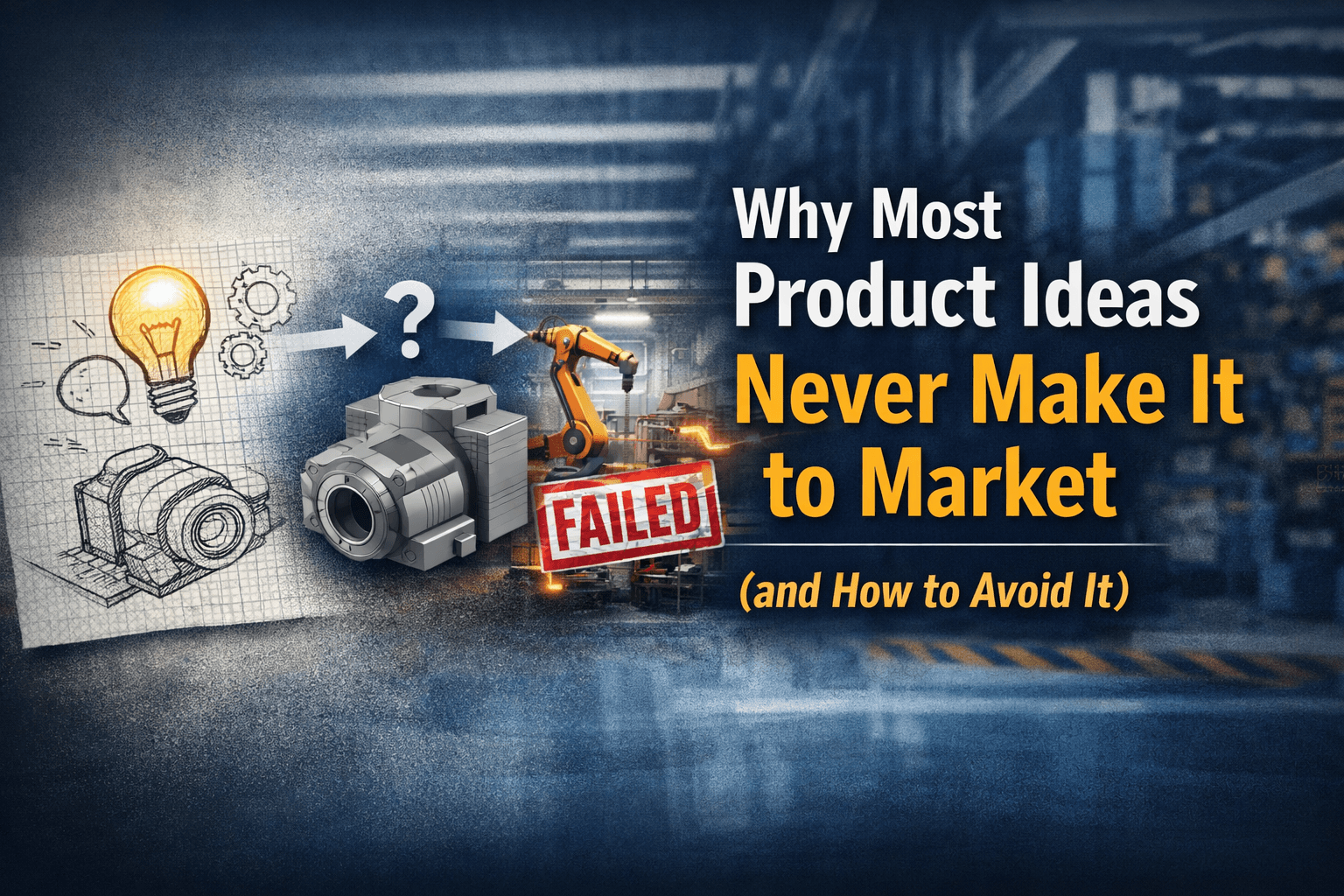
Most product ideas fail not because they are bad, but because they are never developed with real manufacturing in mind. A concept can look great on paper or in CAD, but still fall apart when it is time to build it. The gap between idea and production is where most projects stall.
In my experience working with inventors and companies, the same issues keep coming up. The design is often created without considering how it will actually be manufactured, assembled, or scaled. This leads to unnecessary cost, long delays, or prototypes that cannot realistically be produced beyond a one-off build.
The most common reasons ideas fail
One of the biggest issues is overcomplication. Early designs often include features that are difficult or expensive to manufacture without adding real value to the product. Small design decisions made too early can dramatically increase tooling costs or limit manufacturing options later.
Another common problem is building a prototype that is not aligned with production methods. A part may work in a 3D printed or hand-machined prototype, but that does not mean it can be injection molded, stamped, or efficiently machined at scale. Without considering production early, the transition from prototype to manufacturing becomes a major redesign instead of a simple step forward.
Material selection is also often overlooked. The right material is not just about strength or appearance, but about how it behaves in the chosen manufacturing process. Choosing materials too early without process context can lead to redesigns later in development.
What needs to happen instead
Successful products are built with manufacturing in mind from the very beginning. This means designing around real processes like machining, molding, sheet metal fabrication, or additive manufacturing instead of treating them as an afterthought.
It also means simplifying designs wherever possible. The best products are rarely the most complex. They are the ones that achieve function with the least amount of unnecessary complexity, making them easier to produce, assemble, and scale.
Early-stage design should always include a reality check. How will this part be made? What will it cost at scale? What tolerances are actually required? Answering these questions early prevents expensive changes later.
The goal: a clear path from idea to product
The goal is not just to create a prototype. The goal is to create a clear, direct path from concept to a manufacturable product. When design and manufacturing are aligned from the start, development becomes faster, more predictable, and significantly less expensive.
This is where most ideas succeed or fail. Not in the creativity of the concept, but in how well it is translated into something that can actually be built.
If you are developing a product idea, the most important step is not making it more complex. It is making sure it can exist in the real world.
Insights & Article
